
Broker Strategy
Why You Only Need Two Brokers (and How to Pick the Right Pair)
One broker is a single point of failure. Five is noise. Here is the case for two, and the framework we use to make sure they genuinely diversify your risk.
By M1 Strategic · October 22, 2026 · 8 min read
Key takeaways
- One broker is a single point of failure. More than two is mostly noise.
- Two brokers give you diversified fills, an independent price record, and redundancy.
- Most traders pair two brokers that are secretly the same broker underneath.
- The rule: same standards, different plumbing.
Ask ten serious traders how many brokers they use and you will hear everything from one to seven. The traders with one usually have not been burned yet. The traders with seven usually have, and over-corrected. Both are exposed, just in different ways.
Our view, from years of trading and from working closely with brokers on the other side of the desk, is simple: two is the right number. But only if you choose the pair correctly, and most people do not.
The problem with one broker
A single broker is a single point of failure. If its platform goes down during a volatile session, you cannot manage your risk. If its client-money bank or its prime broker runs into trouble, your entire trading capital is tied up in the same problem. And if it prints a bad price, a spike that never traded anywhere else, you have nothing to compare it against. It becomes your word against theirs.
Even excellent brokers have bad moments. The question is not whether something will eventually go wrong. It is whether you have a fallback when it does.
The problem with five
Spreading across many brokers feels safer, but past two it mostly adds noise. Every extra account means another platform to monitor, another set of statements to reconcile, another KYC renewal, and more margin sitting idle where it is not working for you.
There is a quieter cost too. Volume is leverage. A trader who splits flow five ways is a small client everywhere: stuck on standard pricing tiers, with no relationship to call on when something needs fixing. Concentrate your volume and you become a client a broker will go to bat for.
Why two works
Two well-chosen brokers give you three things one broker cannot, without the overhead of five.
Diversified fills
Splitting your flow across two independent liquidity pools averages out your execution and removes reliance on any single venue.
An independent price record
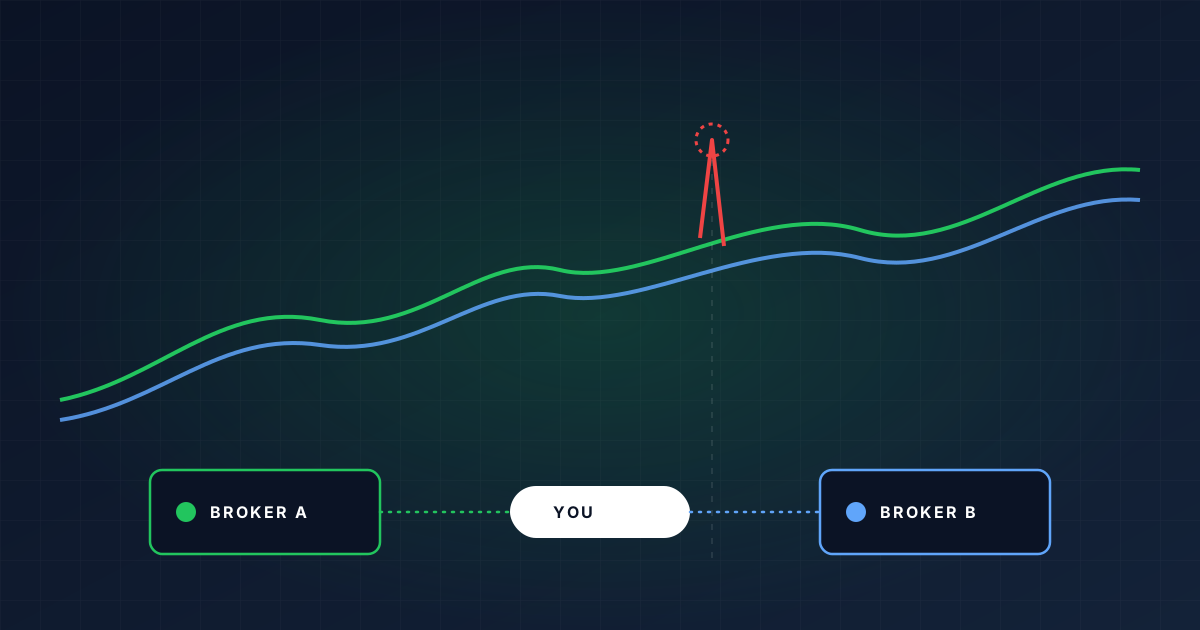
Even the best brokers occasionally print a rogue spread or an erroneous fill. Your other broker's pricing at that exact moment is hard evidence your broker can use to advocate for you with its liquidity providers.
Built-in redundancy
If one platform or connection ever has an issue, you can still manage positions and risk through the other.
The second of those is underrated. If your primary broker fills you at a price that looks wrong, a screenshot of what your secondary broker was quoting at that exact moment is hard evidence. It gives your broker what it needs to take the issue up with its liquidity providers on your behalf, and good brokers will.
The trap: two brokers that are secretly one
Many brokers that look completely different on the surface are built on the same foundations: the same white-label platform, the same prime broker, the same liquidity bridge, even the same bank. Pair two of them and you have not diversified anything. You have duplicated it.
This is more common than most traders realise. In one case we know of, close to ten retail brands, each with its own name, website, and marketing, trace back to a single brokerage operation. To the trader they look like ten choices. Underneath, they are one.
If both brokers source prices from the same place, a bad print shows up on both screens, and your “independent” price record proves nothing. If both rely on the same prime broker, one counterparty problem hits both accounts at once.
The pairing framework: same standards, different plumbing
The goal is two brokers that meet the same quality bar, but share as little underlying infrastructure as possible. Quality should be identical. Plumbing should be independent.
Execution model
Keep the same: Both agency or A-book. Never pair with a broker that trades against you.
Financial standing
Keep the same: Both well capitalised, with long operating histories and clean records.
Regulation & entity
Make different: Different regulators and jurisdictions, with at least one top-tier licence (e.g. FCA, ASIC).
Prime broker & banking
Make different: Different prime brokers and different banks holding client money.
Liquidity
Make different: Independent liquidity stacks, so one broker's prices are a genuine check on the other's.
Infrastructure
Make different: Different servers, and ideally different data centres or connectivity paths (e.g. LD4 and NY4).
Platform
Make different: Ideally different front ends (e.g. MT5 and cTrader, TradingView, or FIX), so one outage never locks you out.
Asset coverage
Make different: Complementary: an FX specialist alongside a multi-asset broker covers almost everything.
Funding
Make different: Different funding rails and base currencies, so a single payment issue never strands your capital.
Costs
Keep the same: Both competitive on an all-in basis (spread plus commission).
Make different: Route each instrument to whichever venue is cheapest for it.
In practice, a strong pair often looks like this: an agency FX specialist under one regulator, banking and clearing in one jurisdiction, paired with an agency multi-asset broker under a different regulator, with its own prime broker and a different platform. Together they cover nearly every instrument a serious trader needs, and no single failure takes out both.
Putting it into practice
- 1
Pick a primary and a secondary
Do not split 50/50 by default. Concentrating most of your volume (say 60 to 70 percent) at your primary earns better pricing tiers and a stronger relationship. Brokers go further for clients who matter to them.
- 2
Fund both properly
Keep enough margin at each broker to act independently. A secondary account too small to trade is not a backup, it is a formality.
- 3
Route by strength
Send larger FX tickets to the deeper book, and products like indices or equities to whichever broker offers them best. Your pair should cover more ground together than either does alone.
- 4
Keep evidence
When a price looks wrong, screenshot both platforms with timestamps straight away. Clear, contemporaneous evidence is what turns a pricing query into a correction.
- 5
Review the pair once a year
Ownership, regulators, and prime broker relationships change. Re-check your pair annually, and immediately if either broker announces a major change.
Common mistakes
- Pairing two white labels that run on the same prime broker or liquidity bridge
- Choosing a second broker for a deposit bonus or promotion
- Spreading capital so thin that neither broker values you as a client
- Opening accounts at four or five brokers 'just in case'
The bottom line
One broker leaves you exposed. Five leaves you distracted and undervalued. Two, chosen so they share your standards but not their plumbing, gives you better fills, a credible record when something goes wrong, and a fallback you can actually use.
The hard part is checking the plumbing. Prime broker relationships, client-money banks, and data-centre locations rarely appear on a broker's website. That is exactly the kind of detail we dig out in our research.
M1 Broker Research
A shortlist built to be paired.
Our reports cover each broker's regulators, prime brokerage, liquidity, banking, and data-centre hosting, so you can see exactly how independent your pair really is. Every broker on our list is one we have traded at ourselves.
See the shortlistThis article is for educational purposes only and is not investment, legal, tax, or financial advice. Trading leveraged products carries a high level of risk. Always conduct your own due diligence before opening an account with any broker.