
Execution
Last Look, Explained: When a Fill Isn't Really a Fill
On a lot of FX liquidity, clicking buy is only a request. Here is how last look works, how it gets abused, and how to check whether it is costing you.
By M1 Strategic · October 22, 2026 · 8 min read
Key takeaways
- With last look, clicking buy sends a request. The provider gets a short window to accept or reject it.
- Used fairly, it is a risk control that helps keep spreads tight.
- Used unfairly, it lets the other side keep the fills that suit it and reject the ones that don't.
- Regulators have fined firms for exactly this, from a global bank to US retail brokers.
- You can spot it in your own fills, and you can ask your broker direct questions about it.
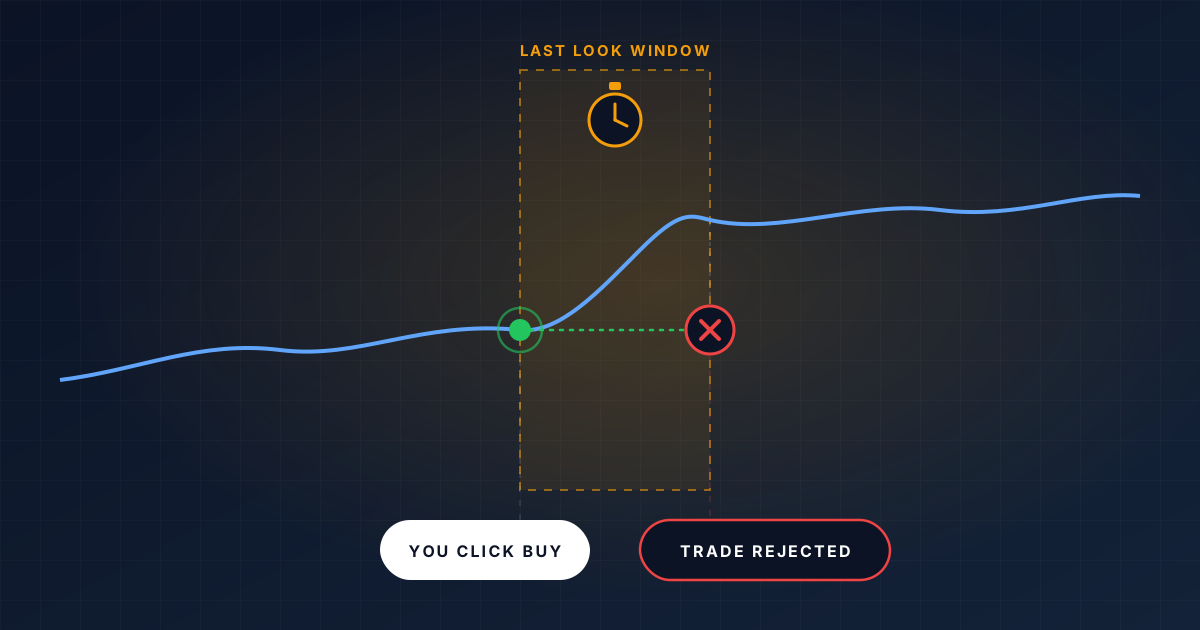
You see a price, you click, and you assume you have traded. On a lot of FX liquidity, you haven't. Not yet. What you have done is ask. Somewhere between your click and your fill, the firm on the other side of the trade gets one more look at your order and decides whether it still wants it.
That final check is called last look. Most traders have never heard of it, yet it quietly shapes how often they get filled, at what price, and how often they see that frustrating “off quotes” message right when the market is moving their way.
What last look actually is
The FX Global Code, the industry's main code of conduct, describes last look as a final chance for the firm receiving a trade request to accept or reject it against the price it quoted. In plain terms: the quote on your screen is an offer the provider can still back out of, for a few milliseconds after you hit it.
- 1
You click
Your order goes out at the price on your screen. At this point it is a request, not a trade.
- 2
The window
The liquidity provider holds the request and checks it: is the price still valid, is the request genuine?
- 3
The decision
It either fills you at the quoted price, fills you at a different price, or rejects the order.
- 4
What you see
A fill, a slipped fill, a requote, or an 'off quotes' rejection. The market may have moved by then.
Why it exists: the fair version
Liquidity providers stream prices to many venues and brokers at once. Prices go stale in fractions of a second, and some fast traders exist purely to pick off quotes that haven't caught up yet. Last look lets a provider check that the price is still valid and that the request is genuine before committing.
The trade-off, at least in theory, is that providers protected by last look can quote tighter spreads. Firm liquidity, where your click is a done deal, usually costs a little more in spread. Neither is automatically better. What matters is whether the last look is applied fairly.
Where it goes wrong
The window is where the abuse lives. There are three main ways a provider can turn a risk control into a profit centre at your expense.
- Asymmetric price checks.If the market moves against the provider during the window, your order is rejected. If it moves in the provider's favour, you are filled at your old, now worse, price. Heads they win, tails you don't trade.
- Extra hold time. Holding your order longer than the checks need gives the market more time to move, which makes the asymmetric check more valuable to the provider. The guidance treats any delay beyond what the checks require as contrary to the Code.
- Trading on your order. Your request tells the provider which way you want to go. Using that information to hedge or trade during the window, or after rejecting you, can push the price away from you before you try again.
Price moves against the provider (in your favour)
Symmetric: Rejected if beyond the tolerance
Asymmetric: Rejected, often with a tight tolerance
Price moves in the provider's favour (against you)
Symmetric: Also rejected if beyond the tolerance, or filled with the improvement passed to you
Asymmetric: Filled at your original, now worse, price
Net effect over many trades
Symmetric: Rejections and slippage roughly balance out
Asymmetric: You keep the bad fills and lose the good ones
This has been punished before
Barclays, 2015.New York's Department of Financial Services fined Barclays an additional $150 million after finding its last look system automatically rejected client orders that would have lost the bank money because of price moves during the hold period. Clients who asked were given vague answers or told it was a technical problem. The bank also agreed to terminate its global head of electronic FICC automated flow trading.
FXCM, 2011. The NFA fined FXCM $2 million for keeping the gains from asymmetric positive slippage and ordered it to credit affected customers. FXCM settled without admitting or denying the allegations.
FXDD, 2012.The NFA alleged FXDD applied a two-pip slippage tolerance only when the market moved in the customer's favour, rejecting those orders, while filling orders at any distance when the market moved in FXDD's favour.
The rules today
Principle 17 of the FX Global Code says last look should be fair, transparent, and used only as a risk control for price and validity checks. The Global Foreign Exchange Committee tightened this in 2021 with guidance that says providers should run their checks without unnecessary delay, should not use your request to trade or hedge during the window, and should disclose whether their price check is symmetric or asymmetric. It also published a standard disclosure cover sheet so providers can set out their practices in one place.
Two caveats. The Code is voluntary, not law, so a firm that hasn't signed up isn't bound by it. And critics point out the guidance still stops short of banning asymmetric checks outright. It requires them to be disclosed. That puts the burden back on you to ask.
What it looks like from a retail account
Retail traders rarely see the words “last look”. They see its effects: requotes, “off quotes” or “price changed” rejections, and slippage. Some of that is normal in a fast market. The question is whether it is even-handed. Watch for these patterns in your own trading:
- Rejections and requotes cluster when the market is moving in your favour, rarely when it moves against you.
- Slippage is almost always negative. Genuine market slippage should go both ways over time.
- Rejected orders take noticeably longer to come back than accepted ones.
- The price often runs away from you right after a rejection, as if your order told someone where you were going.
- Your broker cannot tell you why a specific order was rejected, or gives a vague 'technical issue' answer every time.
A simple test: export a few months of trade history and compare your requested price with your fill price on every order. If the differences are spread on both sides of zero, the execution is probably fair. If almost all of them sit on the wrong side, something in the chain is keeping the good fills for itself.
A second broker helps here too. A timestamped screenshot of another broker's quote at the moment you were rejected is the best evidence you can bring to a complaint. It is one of the reasons we argue you only need two brokers, chosen so their liquidity is genuinely independent.
Questions to ask your broker
A good broker will answer these plainly. Many retail brokers sit between you and several liquidity providers, so the honest answer may be “it depends on the provider”, which is fine as long as they can tell you which.
- Do your liquidity providers apply last look on my orders? Which ones do, and which offer firm prices?
- Is the price check symmetric or asymmetric?
- What is the maximum hold time, and is any delay added beyond the checks themselves?
- Do you pass positive slippage on to clients as well as negative?
- Can you give me fill, rejection, and slippage statistics for my account?
- Do your providers publish a GFXC disclosure cover sheet?
If the answers are evasive, or the broker cannot produce statistics for your own account, treat that as an answer in itself.
The bottom line
Last look is not a scam on its own. Applied symmetrically and quickly, it is a reasonable trade-off that helps keep spreads tight. Applied asymmetrically, with extra hold time, it quietly turns your best entries into rejections and leaves you holding the worst ones. The difference won't show up in a broker's advertised spread. It shows up in your fills.
M1 Broker Research
Execution you can check, not just trust.
Our reports cover each broker's execution model, liquidity providers, and infrastructure, so you know who is really on the other side of your fills before you open an account.
Explore the researchSources
- GFXC: guidance paper on last look and disclosure templates (Aug 2021)
- GFXC: Execution Principles Working Group report on last look
- GFXC: disclosure cover sheets
- Private Banker International: Barclays to pay $150m to NYDFS over last look (Nov 2015)
- BabyPips: NFA fines FXCM $2 million over asymmetric slippage (Aug 2011)
- Finance Magnates: NFA charges FXDD including asymmetric slippage (Jul 2012)
- The Full FX: Has the FX market finally solved last look?
This article is for educational purposes only and is not investment, legal, tax, or financial advice. Case summaries reflect public regulator announcements and press reports at the time; settlements without admission are not findings of wrongdoing. Trading leveraged products carries a high level of risk.