
Regulation
Managing Money for Americans Offshore: The “Tech Vendor” Loophole That Isn't
Copying trades into US clients' accounts at an offshore broker and earning rebates on their volume is sold as software. US regulators call it something else, and it can end in prison.
By M1 Strategic · October 22, 2026 · 12 min read
Key takeaways
- Trading other Americans' forex accounts for a fee requires CFTC registration as a CTA. Copying trades into their accounts counts.
- Earning rebates on US clients' volume at an offshore broker is introducing-broker activity, which also requires registration.
- Calling yourself a “technology vendor” does not change what the CFTC looks at: who makes the trading decisions.
- Receiving trades on a copier is not buying an EA. The client owns no code; someone else is trading their account.
- Willful violations of the Commodity Exchange Act are a federal felony, with up to 10 years in prison per violation.
- Where fraud is involved, sentences get far longer. Two executives behind Mediatrix Capital and Blue Isle Markets received 23 and 24 years.
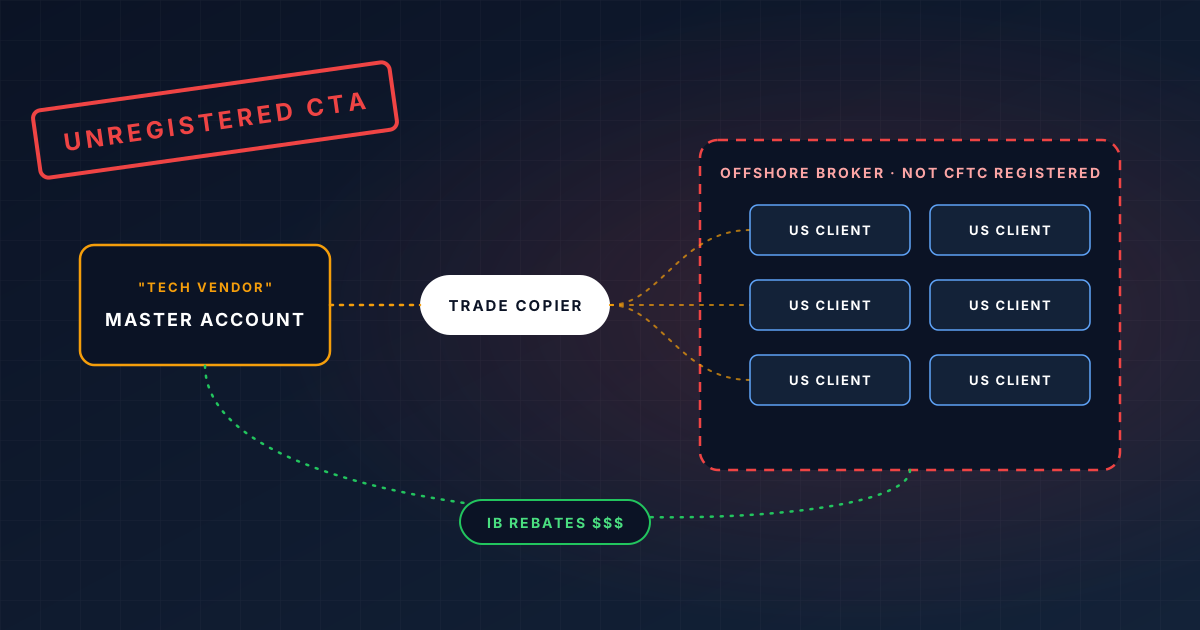
There is a business model that has quietly become one of the most common in retail forex. A trader or firm in the US builds a strategy, an “algo”, or a following. Their clients, mostly Americans, open accounts at an offshore broker that will take them. The firm connects those accounts to its own through a trade copier, MAM, or PAMM. It charges a monthly “software subscription” or a performance fee, and on top of that the broker pays it a rebate on every lot its clients trade.
It looks clever. Everybody seems to win. In reality, it can stack three separate and very serious violations of US law on top of each other, and the people running it are the ones with the most to lose, especially if they are American themselves.
Three layers of exposure
Trading their accounts: unregistered CTA
Anyone who, for compensation, advises others on retail forex or directs trades in their accounts is a Commodity Trading Advisor under US law and must register with the CFTC and join the NFA. Copying your trades into a client's account is directing trades in that account, whatever the invoice says.
Earning rebates on their volume: unregistered IB
Bringing US retail clients to a forex dealer and being paid on their flow is introducing-broker activity. US rules require IBs in retail forex to register too. Being paid per lot by a broker the client was steered to also creates a direct conflict: you earn more when the client trades more, win or lose.
Sending them offshore: an unregistered counterparty
The broker itself is generally not allowed to deal retail forex with US residents without CFTC registration. Steering clients there puts their money with a firm outside the US system, with no NFA arbitration, no US capital requirements, and no one to call if it goes wrong.
Any one of these is a problem. Together, they describe someone who moved clients outside US protection, managed their money without a licence, and was paid on both ends while doing it. That is not a story any regulator, prosecutor, or jury finds sympathetic.
The “technology vendor” grey area
The usual defence is that the firm is a software company. It does not manage money, the argument goes. It sells access to a tool, and the client chooses to switch it on.
There is a genuine grey area here. Software that a trader configures and controls, where the trader sets the parameters and makes the decisions, is generally treated differently from someone directing trades. But a trade copier that mirrors one person's trades into many clients' accounts is not that. The trading decisions are being made by the person running the master account. The client's only decision was to hand them over.
Watch for a second tell. Many vendors say publicly that clients can run their software “at any broker you wish”, while their marketing privately pushes clients towards offshore brokers where the vendor has an introducing-broker deal. Often that is because the strategy cannot run at a US broker at all: it needs more leverage than US rules allow, or it relies on hedging and position handling that US FIFO and anti-hedging rules prohibit. If you are American and the product cannot trade properly at a US-registered broker, that alone tells you most of what you need to know.
Not every “algo” is the same thing
This is where the loophole hides, because a trade copier is often an algo too. Both kinds install the same way and both can be sold as “our algorithm”. They are completely different things:
- A self-contained algo. The strategy is in the code you bought or licensed, for example an EA from the MQL5 Market. It runs on your platform and makes its own decisions. You own the tool.
- A receiver algo. The code on your platform has no strategy of its own. It listens for a master signal from the vendor and copies the trades. The decisions are made somewhere else, by someone else, in real time.
The test is not whether something is called an algo. It is where the trading decisions are made. If they are made by the vendor and land in the client's account, that is managing the client's account through a piece of software, not selling software.
US law draws its line in the same place. The CFTC's own exemption for general, impersonal trading advice is expressly unavailable to anyone who directs client accounts or tailors advice to particular clients.
“Generally software” is not a free pass: fraud and misleading performance claims are illegal whatever you sell. And any of these can become registrable once you earn rebates on the client's trading or solicit them into a particular broker.
The CFTC has already applied this to copier and autotrader businesses. Here are just a few examples. In the first two, the product was sold as software and the firm was treated as an unregistered trading advisor anyway. The others show where the same model leads: managed accounts that went wrong, and the offshore set-ups that make it possible.
Forex Entourage (Utah)
Customers linked their retail forex accounts at unregistered dealers to the firm's master account, and every trade was duplicated into their accounts through its autotrader programs, marketed as “100% hands free trading.” The CFTC found the firm acted as an unregistered CTA and its two owners as unregistered associated persons. US$150,000 penalty and a cease-and-desist order, settled without admitting or denying the findings.
Silver Star FX / Silver Star Live (multi-level marketing)
Sold a “forex autotrader” for a fee plus a monthly subscription, and had customers link their retail forex accounts to it. The slogan was “Our Trades, Your Account.” The CFTC found the companies exercised discretionary trading authority and acted as unregistered CTAs. US$75,000 penalty and a cease-and-desist order, settled without admitting or denying the findings.
Tradewale LLC and Tradewale Managed Fund (UK)
The CFTC sued, alleging the firm solicited the public to deposit funds into accounts it managed for forex trading, promising AI-driven returns with “minimal risk,” acted as an unregistered CTA, and diverted customer funds. Most US customers reportedly could not withdraw. Allegations only at the time of filing.
Netrios (Saint Lucia) and Red Acre (Malta)
Netrios supplied a white-label package that let offshore brands offer leveraged trading to US retail customers. Red Acre handled onboarding, support, and marketing on the customer side. Neither was registered. US$2.5 million in combined penalties, settled without admitting or denying the findings. The firm that only handled the client-facing side was charged too.
Some of the best-known US “algo” and copy-trading brands describe themselves as technology providers, and it is widely discussed among traders how much client volume runs through offshore brokers this way. We are not commenting on any particular firm. The point is that the label carries little weight. What matters is who decides the trades, whose accounts they land in, and who gets paid.
The worst case, in numbers
Most registration cases end in civil penalties and bans. But every penalty in US commodities law is counted per violation, and the worst case is far heavier than a fine. Here is what the statutes allow.
Civil, per violation
The greater of roughly US$227,000 (the CFTC's current inflation-adjusted figure) or three times the money made from each violation. Courts can also order restitution of every client's losses and disgorgement of every fee and rebate, plus permanent trading and registration bans.
Criminal, per violation
A willful violation of the Commodity Exchange Act is a federal felony: up to 10 years in prison and a US$1 million fine for each one.
Wire fraud, per count
Once statements are dressed up, losses hidden, or client money diverted, prosecutors reach for wire fraud: up to 20 years in prison for each count. The Mediatrix executives were convicted on 14 of them.
And once client money is involved, the case rarely stays a registration case for long. Losses get hidden. Statements get “adjusted”. Fees keep being taken. That is where it stops being a regulatory problem and becomes a prison sentence.
Case study
Mediatrix Capital and Blue Isle Markets: 47 years in prison
Michael Shawn Stewart and Bryant Edwin Sewall ran Mediatrix Capital and Blue Isle Markets from the Caribbean, selling investors an algorithm-based forex trading program. They claimed a winning record with no losing months. In reality the firm had many losing months, and investors were sent statements showing only the winning trades.
According to federal prosecutors, investors were promised over US$179 million. Their accounts actually held US$9.8 million. Insiders called the gap “the hole.” The firm lost about US$32 million trading while collecting about US$28 million in performance fees, and used Blue Isle, its own brokerage, to take more than US$45 million in markup fees on client trades. The money went on real estate, boats, cars, and jewelry.
A federal jury convicted both men in May 2024 on 14 counts of wire fraud and one of conspiracy. Sewall was sentenced to 23 years. Stewart was sentenced to 24 years and ordered to pay over US$93 million in restitution. A third partner pleaded guilty to lying to the SEC and was sentenced to a year and a day. Back in 2019, the SEC had brought an emergency action and obtained an asset freeze to halt the scheme.
Notice the structure: an offshore setup, an algorithm, and an affiliated broker earning on every client trade. The markups were not a side detail. They were one of the main ways client money was extracted.
The excuses that don't work
“We sell software, not advice.”
If your trades end up in the client's account without the client making each decision, regulators look at what actually happens, not the label. The autotrader cases above were all sold as products.
“The client chose the broker, not us.”
If you recommended the broker, if your product only works at brokers you have a deal with, if you sent the sign-up link, or if you get paid on the client's volume there (quite often privately), you are part of how they got there.
“We're not in the US, so US rules don't apply.”
The CFTC regularly acts against foreign firms dealing with US customers. That is what the RED list and most of the cases above are about. The US regulators' job is to protect Americans, wherever the firm taking their money is based.
“Clients can use our software at any broker they like.”
Then it should work properly at a US-registered broker, within US leverage limits and FIFO. If in practice it only works offshore, and marketing quietly steers clients to the brokers you have rebate deals with, the public line is not the real one.
“The clients signed a disclaimer.”
A client cannot waive a federal registration requirement on your behalf. A disclaimer may also be used as evidence that you knew the issue existed.
What it does to the clients
The people who pay first are usually the clients. Their money sits with a broker outside the US system, so there is no NFA arbitration and no US capital requirement behind it. If the broker is added to the CFTC's RED list, its banks and payment providers may pull back, and withdrawals can stall for everyone. If the manager disappears, the client is left with an offshore account, a trading history they did not control, and nowhere to complain.
We covered how that chain plays out, including the case of OX Securities, in the hidden dangers of offshore brokers that accept Americans.
Doing it properly
None of this means Americans cannot have their money professionally managed in forex. They can. There are really only two routes we would consider safe: an NFA-registered Commodity Trading Advisor trading the client's account at a US-registered dealer or FCM, or a properly structured fund, run by a registered or properly exempt operator, that admits only accredited or otherwise qualified investors. Everything else, from signal groups to copiers to “tech subscriptions”, sits somewhere between a grey area and a violation. For a manager, doing it properly looks like this:
- Register as a Commodity Trading Advisor with the CFTC and become an NFA member, with the required proficiency exams and a forex associated person among the principals.
- Provide clients with a proper disclosure document covering the strategy, fees, conflicts, and track record.
- Trade client accounts at a CFTC-registered dealer or futures commission merchant, or run the strategy through a properly structured fund open only to accredited or qualified investors.
- Disclose every way you are paid, including any rebate or commission on client volume, or better, don't take one.
- Get a lawyer who specialises in CFTC and NFA work before you take your first client. Exemptions exist, but they are narrow and easy to get wrong.
It is more work and more cost. It is also the difference between running a business and running a liability.
Regulated funds: worth seeking out
For investors who qualify, a properly regulated fund is often the most credible option of all, whether it is based in the US or abroad. Offshore does not automatically mean unregulated. Well-established fund jurisdictions include Delaware in the US, the Cayman Islands, the British Virgin Islands, Bermuda, Luxembourg, and Ireland, and properly structured funds in these places work with American investors under the right exemptions. What they have in common is layers of independent oversight that a copy-trading service will never have.
Independent audit
Annual audits by an independent firm. In the Cayman Islands, for example, registered funds must be audited every year by a CIMA-approved local auditor.
Directors with duties
Directors or a general partner who owe fiduciary duties to the fund and its investors. Cayman requires at least two registered directors for a corporate fund.
Fund administration
Most established funds appoint an independent administrator to calculate the NAV and handle subscriptions and redemptions, so the manager does not mark its own homework.
Regulatory filings
Funds file returns and audited accounts with their regulator, and can usually be looked up on a public register.
The trade-off is access. These funds usually carry higher minimums (registered Cayman funds, for example, typically require US$100,000 or more), and US investors can generally only come in as accredited or otherwise qualified investors, under the proper US exemptions. Many funds, especially European ones, do not accept US investors at all, so ask first. That is by design: these structures are built for investors who can carry the risk, and the oversight comes with real cost. If you qualify, ask for the offering documents, check the auditor, administrator, and directors by name, and confirm the fund on the regulator's register yourself. Our regulator guide explains how the major regulators compare.
If someone is managing your money
If you are an American, before you let anyone trade your account, or link it to their copier or “algo”, check these yourself:
- Look up the manager on NFA BASIC. If they direct trades in your account for a fee, they should appear as a registered CTA.
- If you are being offered a fund, ask who operates it, whether they are registered or relying on a specific exemption, and why you qualify to invest.
- Look up the broker on NFA BASIC, and check it is not on the CFTC RED list.
- Ask, in writing, whether the manager or anyone involved earns rebates or commissions on your trading volume.
- Ask for the offering paperwork: a disclosure document from a CTA, or a private placement memorandum (PPM) or offering memorandum (OM) from a fund. Registered CTAs managing client accounts generally must provide a disclosure document before taking your money, and a legitimate fund will not take a subscription without one.
- Ask whether you own or license the algorithm and its logic, or whether it is a copy-trading algo that receives trades from the vendor's master account.
- Ask whether it can trade properly at a US-registered broker, within US leverage limits and FIFO. If you are American and the answer is no, that alone is probably all you need to know.
- Be wary of statements you cannot verify independently with the broker. Fabricated statements were at the heart of the Mediatrix fraud.
The bottom line
Managing Americans' money through an offshore broker, copying trades into their accounts, and collecting rebates on their volume is not a loophole. It is a stack of registration violations that regulators have already prosecuted, sold under a software label they have already looked past. When client money goes missing on top of it, the outcome can be decades in federal prison. If you are doing this, stop and speak to a lawyer. If someone is doing it with your money, check their registration today.
Don't roll the dice
US regulators have a very long reach, and they have shown it time and again.
The CFTC, the NFA, the SEC, and federal prosecutors have pursued firms in St. Vincent, the British Virgin Islands, Saint Lucia, Malta, and the Caribbean, and put the people behind them in federal prison. Being offshore, calling it software, or hiding behind a disclaimer has not stopped them before. Don't tempt fate.
M1 Broker Research
Know exactly who you are dealing with.
Our reports cover each broker's licences, the entity you actually sign with, who it accepts, and its regulatory and legal history, so you never end up on the wrong side of the rules by accident.
Explore the researchSources
- US Attorney's Office, D. Colorado: second Mediatrix executive sentenced to 24 years (Jul 2026)
- US Attorney's Office, D. Colorado: Mediatrix executive sentenced to 23 years (Nov 2024)
- CFTC order: Forex Entourage, LLC (Sep 2018)
- CFTC order: Silver Star FX, LLC (Nov 2019)
- CFTC: charges against Tradewale LLC and Tradewale Managed Fund (Sep 2021)
- Finance Magnates: CFTC fines Netrios and Red Acre $2.5 million (Jun 2026)
- 7 U.S.C. § 13: criminal penalties under the Commodity Exchange Act
- 17 CFR § 5.3: registration of retail forex CTAs, CPOs, and IBs
- NFA: who has to register as a CTA
- Barnes & Thornburg: when technology providers may need to register as CTAs (2023)
- CFTC: RED (Registration Deficient) list
- 17 CFR § 4.14: CTA registration exemptions (incl. (a)(9), not available for directing client accounts)
- FindLaw: Taucher v. Born, CTA registration and impersonal advice (1999)
- 7 U.S.C. § 13a-1: civil penalties, restitution, and disgorgement
- CFTC: inflation-adjusted civil monetary penalties
- 18 U.S.C. § 1343: wire fraud
- SEC: emergency action halting Mediatrix Capital offering fraud (Sep 2019)
- Collas Crill: Cayman Islands mutual funds (registration, audit, directors)
- CIMA: investment funds
- NFA BASIC: check a firm's registration
This article is for educational purposes only and is not legal, investment, tax, or financial advice. It is a general summary of US rules and public enforcement records, not an assessment of any particular firm's conduct. Regulatory settlements entered without admitting or denying findings, and allegations in complaints, are not findings of wrongdoing unless a court or regulator has so determined. If you manage money or earn compensation from US clients' trading, consult a qualified CFTC/NFA attorney about your situation. Trading leveraged products carries a high level of risk.